Showing posts with label Alexandru Murariu. Show all posts

24 November 2018

A Northumbrian Anthem, an update


That contemporary music has distanced itself from society is a frequent contention. That society has given up on new music is the obverse claim. 

A simplistic view would be that educated composers have secluded themselves in ivory towers where rarified music is heard by a few connoisseurs, mostly other composers. They compose for themselves and for each other, and they regard any concession to the public taste as a betrayal of high art’s precepts. This, of course, is an unhealthy state of affairs, and the remedy for it is for composers to write accessible music that is designed to be heard by a general audience.

At the other end, an equally simplistic view would be that concert audiences and concert promoters have become lazy, philistine and averse to risk, as a result of which concert programmes have become conservative, excluding music written in the last century. This is seen as a symptom of a decaying society, spread by the contagion of easy consumerism. A healthy reaction to this is for composers to keep their integrity in the face of adversity, adhering unyieldingly to their aesthetic values in the face of the incomprehension of audiences and promoters. 

Each of these simplistic views has no shortage of proponents, but most intelligent people on both sides would take a more nuanced approach. This is not the blog entry where I intend to discuss the issue in depth. Will I ever? I expect I will, but not just yet. Sitting on the fence would be an evasion; coming out in favour of one contention or its opposite would give the growing number of my detractors even more rope with which to hang me. 

Today I mention the above debate only by way of context. Regardless of where one stands as a composer, it is a fact that there are times when a piece or project demands that one engages with the audience more directly than may be one’s habit. That is the nature of some projects. If one doesn’t like it, one is free to pass up the opportunity. If one accepts it, one has to deliver. It would be difficult to imagine Boulez, Ferneyhough or Barrett agreeing to be involved in such a project. But for those of us who, as well as wanting to keep challenging standards of rigour and innovation also want to keep a dialogue with society going, the ‘direct engagement’ proposition is appealing. 

In this particular case, the proposal came from a source which at the time was close to me. The piece needed to be short, simple, accessible to a general audience, with a positive feeling and - this was the key descriptor - anthemic. It was to be for organ. The fact that there was a commission fee, but that, in keeping with the spirit of the occasion, it was suggested that I should donate it to charity, made the challenge more quixotic and, for that reason, more appealing. 

After accepting the commission, I confess to feeling a great deal of trepidation. I am no stranger to straightforward, diatonic, tonal, singable writing. I had done lots of it for my friends in Bolivia, chiefly the choirs at Instituto Laredo in Cochabamba.

Choral writing is a time to be tonal. This used to be a contentious notion, but the best-known composers currently producing for the medium in England and Scotland seem to accept it. Through familiarity with the people and their music (say, Tavener, Weir, Casken, MacMillan) one can feel surrounded by a relevant context. To be anthemic in that framework would be, for the composer, a natural extension, a question of channelling the available means in a particular direction, a point of focus. 

But the organ? Having never done it before, I felt the sheer fact of writing for the instrument was a steep enough challenge. And then, what was the contemporary context for organ writing with an anthemic character? I found an inspiring precedent in a work by the young Romanian composer Alexandru Murariu, Espaces IV Spezzati. Written for double choir and (single) organ, this beautiful piece is stirring indeed. In terms of the number and density of the notes it probably has the right degree of simplicity for my ‘anthemic’ challenge. But the aesthetic breadth of Murariu’s statement is on a grander scale than I understood my commission to require. Much as I enjoy listening to Murariu's piece, for my project a more demotic approach was required, one that would engage a diverse audience on more than one level of perception: accessible on the surface, melodious to the point of hummability, and also solidly constructed and capable of standing up to analytical scrutiny. 

Is it possible for a composer to write something that will stir a community in and 'anthemic' way and to remain true to oneself, avoiding a pastiche of old masters of the anthem - Walton, Elgar, even more ancient precedents? Would my own youthful and not so youthful anthemic vein, hitherto for Latin American consumption, be applicable to this project? Would I be able to manipulate these stylistic parameters to articulate the right statement? These and other questions preoccupied me, delaying the start of composition.  

In the meantime, events of a life-changing magnitude supervened. From one day to the next, I woke up to a new reality where it was not possible to know whether anything could go ahead as planned. I tried to salvage as much as I could, at least the things over which I had some control. The pieces I had committed to write were among the battles to be fought, and I fought them. In the hardest conditions, I wrote every one of them - well, it was only three pieces, but that was a hard enough challenge in the circumstances. A Northumbrian Anthem was completed as requested. I honoured my part of the deal.  

Tonight should have been the première. Whether it went ahead, I do not know. What I offer here is - yet again - a computer simulation. 


25 June 2018

Sigismund Toduță Festival 2018


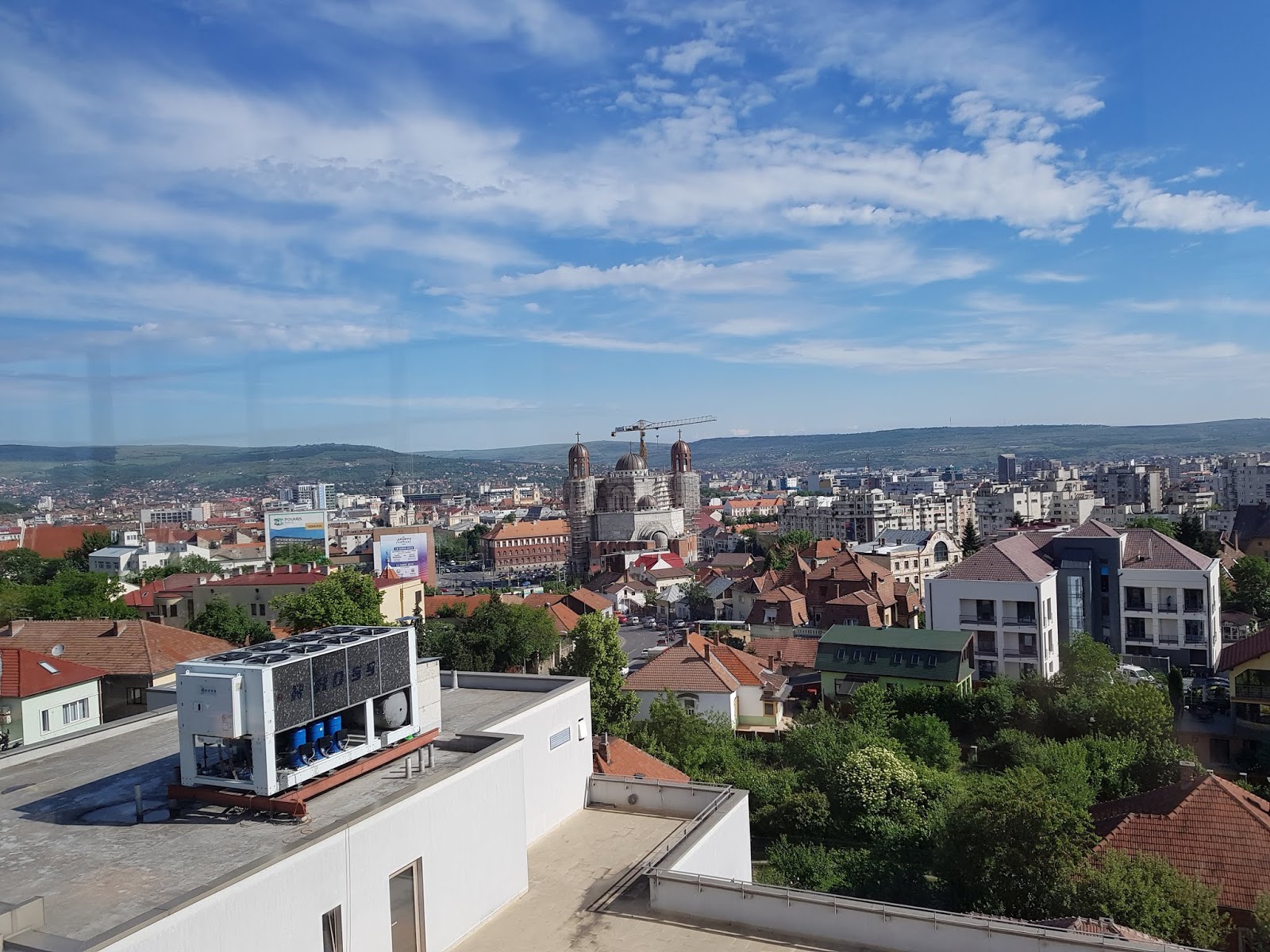
With some delay I write a few lines on this year’s Sigismund Toduță Festival, which took place from 11 to 17 May in Cluj-Napoca. This year’s was my third visit to the Festival.


The Festival is an impressive display of organisation by the staff at Academia de Muzică Gheorghe Dima, with strong support from a group of students in musicology and music management. They have established a tradition of running an international conference in parallel to a programme of concerts and masterclasses. The performers are staff and students from the Academy. The participants in the conference are staff and guests from other parts of Romania and from abroad. The programmes have a predominance of contemporary Romanian music, not excluding their own, that is, music by professors, graduates and students from the Gheorghe Dima.

My links with Romania, which I consider an important part of my life, hinge on the connection with the Sigismund Toduță Festival. (The relationship with the National Music University of Bucharest is less assiduous, although much valued too). Every time I go to Cluj I find new reasons to be impressed and grateful. This time the Festival had the good grace to recommend that the Academy award me an honorary doctorate, and the Academy had the good grace to agree.


The conferral took place in a short and tasteful ceremony on 15 May in the AMGD Hall. The wonderful composer Adrian Pop, a professor at the Academy, read the citation – referred to in Romanian by its Latin name, laudatio. This was an impressively well-researched outline of my life and career, prepared with no previous consultation with me. I had known Adrian Pop as an exceptionally gifted composer and, through the work of his disciples, as an inspirational teacher. As he expatiated on me, I was overcome by admiration for his gifts as a researcher too. Even the most loyal reader of this blog will agree that to prepare a lecture on me is not a simple matter of searching in one’s local library.

The ceremony was well organised and it ran smoothly. A group of staff and students were in attendance - people who, over the years, I have grown to esteem and like.    

The following day, a work of mine was performed by Jubilate Choir under Mihaela Cesa-Goje. The work is Tres canciones sobre poemas de Rachel, composed in 1976. In my previous visit to Cluj, they had chosen Notes from Underground and they had assigned the impressive Cappella Transylvannica and baritone Christian Hodrea to the task. Composed in 2016, Notes from Underground was then my most recent piece. There are forty years between these two works. If there is a hidden meaning to this neat symmetry I am yet to uncover it; it may just be  an elegant, but wholly accidental quirk of life, with no hidden meaning.

The concert on 16 May was also an opportunity to hear another work by the prolific Alexandru Murariu, Espaces IV. This is a beautifully crafted antiphony for choir and organ, which worked very effectively in the reverberant space of Cluj’s Piarist Church. 
Together with Sebastian Țună – with whom I also had the opportunity to become better acquainted – Murariu brings an injection of freshness and creativity to new music in Romania. I have faith that these two young composers’ sphere of action will spread; they deserve a wider audience.


Leaving Cluj felt harder this time. In my last few hours there I completed a valedictory message I had started in 2016 and I put it up on social media - and on this blog - as a parting present. A few days later, a talented student at the Academy, Edith Gergely, prepared a Romanian translation. I reproduce it below with her permission.


19 May 2018

Farewell to Cluj 2018


Well, even the most beautiful things must come to an end, although in their beauty lies an assurance that they will live on.
Thank you, Academia de Muzică Gheorghe Dima, for your generosity and kindness towards me.
Thank you, Prof Banciu and Mrs Banciu, Adrian Pop, Edith Gergely and Oana Balan for looking after me so well.
Thank you, Mihaela Cesa-Goje and Jubilate Choir, for doing my work with such commitment and good results.


Thank you, Alexandru Murariu, Sebastian Țuna and Cristian Bence-Muk, for inspiring me with your vibrant music.
Thank you, Oana Andreica, Virgil Mihaiu, Cristina Şuteu and Bianca Temeş for stimulating conversations at Olivo.
Congratulations to International Festival Sigismund Toduța for a festival that keeps going from strength to strength.
Congratulations also to all the student composers and players, and to the participating professors, for all that splendid music.
It was a joy to see 'my' Year 4 again, and to meet the younger students - one of them a few months old.


Leaving Cluj this morning (18 May), the same words came back which I had begun to jot down on my mobile phone when leaving Cluj two years ago. I completed them just now. The short lines may look like a poem, but are not intended as a poem - unless one defines poetry as the inability to express thoughts in articulate prose. (A piece of music would take too long for this purpose.)


Un último beso a tus calles, Cluj,
una última caricia de mis ojos
a tus murallas.
Suena el rumor de tus bosques
en tu música
Toduță, Türk, Țăranu
Pop, Țună, Murariu.
Habla tu historia
de sangre y fronteras
de reinos e imperios
pasiones, pensamientos, iluminaciones
en los ojos de tu gente
en sus rostros, en sus rasgos.
Se oye tu pasado
en las voces onduladas
que pueblan el aire.
Tu presente
rompe murallas
alza barreras
sana heridas.
Vibras, Cluj,
y reverberas
con eco largo.
¿Cuándo terminas, y dónde?
Tus límites no se ven
aunque tu ausencia se sienta.
Resonarás, persistente
más allá del bosque
más allá de la razón.
Aún así,
largo se hará el tiempo
sin besar con mis ojos las calles
sin tocar los muros
sin sentir las voces
de Transilvania.

 
Site Meter